On May 27, Professor Hu Ying’s team from the School of Life Science and Technology at Harbin Institute of Technology achieved a significant breakthrough in the regulatory mechanisms and targeting strategies of the oncogene KRAS. Their research, titled Farnesylation-Driven KRAS Phase Separation Promotes Colon Tumor Growth, was published in the top-tier international journal Cell. This marks the first time the university has published a paper in Cell as the primary affiliation.
The study is the first to reveal that farnesylation modification drives liquid-liquid phase separation (LLPS) of KRAS, leading to the formation of functional condensates in the cytoplasm that promote colon cancer growth. The team also discovered that statins can effectively intervene in this process, providing a novel strategy and potential drug option for the precise treatment of KRAS-driven tumors.
KRAS is one of the most important driver genes in human cancers, with extremely high mutation rates in pancreatic ductal adenocarcinoma (~90%), colorectal cancer (~50%), and lung adenocarcinoma (~30%). It has long been considered a classic undruggable target. Although the world’s first KRAS inhibitor, AMG 510, has been approved, patients often develop rapid resistance within months, highlighting the urgent need for new (combination) targeting strategies. However, current research has mainly focused on KRAS activity regulation and signal transduction at the cell membrane, while the precise regulatory mechanisms and efficient transport of KRAS in the cytoplasm remain poorly understood. This cytoplasmic regulatory blind spot has limited a comprehensive understanding of KRAS activation and the development of KRAS inhibitors.
In clinical samples of colorectal cancer, the research team found that KRAS proteins form abundant condensates in the cytoplasm, with significantly higher numbers in tumor tissues compared to adjacent normal tissues. These condensates are closely associated with advanced tumor progression, invasion, metastasis, and poor patient prognosis. This phenomenon was also observed in lung cancer and pancreatic cancer, suggesting that KRAS condensates may represent a critical mechanism driving KRAS activation and tumor progression.
Further mechanistic studies revealed that farnesylation at the C185 site confers strong hydrophobicity to KRAS, serving as a novel driver of phase separation. This finding introduces a new concept: post-translational acylation modifications can drive protein phase separation. Moreover, KRAS condensates efficiently recruit RCE1, promoting KRAS processing and translocation to the plasma membrane. The team also discovered for the first time that growth factor stimulation promotes KRAS condensate formation, establishing a positive feedback loop that amplifies growth signals — an important addition to the traditional understanding of growth factor-mediated KRAS activation.
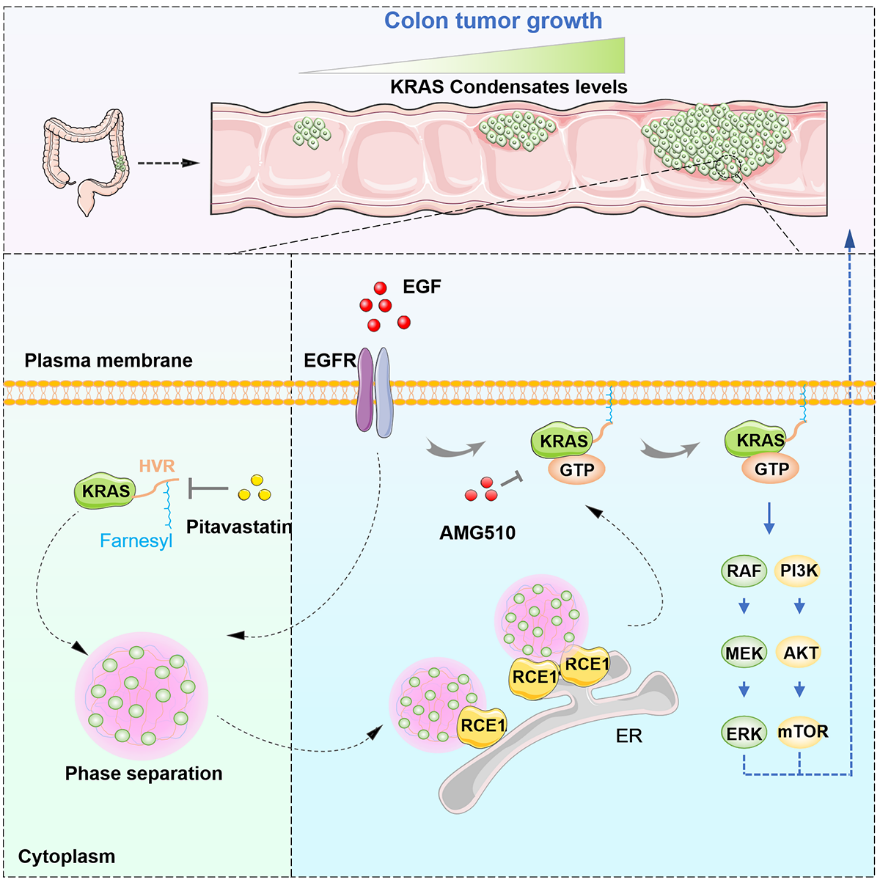
Schematic diagram of farnesylation-driven KRAS phase separation promoting colorectal cancer growth
By screening an FDA-approved drug library, the team found that widely used lipid-lowering statins can effectively disrupt KRAS phase separation, with pitavastatin showing particularly strong effects. In animal models, patient-derived xenograft (PDX) models, and organoid models, pitavastatin was shown to block KRAS phase separation, inhibit tumor growth, and significantly restore sensitivity in AMG 510-resistant tumors.
In summary, this study uncovers a novel mechanism by which KRAS achieves efficient signal transduction in the cytoplasm, reveals a new paradigm of biomolecular phase separation driven by acylation modifications, and provides fresh insights and potential targeting strategies to address the undruggable nature of KRAS and overcome clinical drug resistance.
Harbin Institute of Technology is the primary affiliation of the paper. Professor Hu Ying from the School of Life Science and Technology is the corresponding author. Associate Researcher Wang Xingwen and PhD student Zhang Yi are the co-first authors.The research received support from Dr. Hou Guixue of BGI-Shenzhen, Professor Ji Hongbin of Westlake University, Associate Researcher Tong Xinyuan of Shanghai Chest Hospital, Professor Li Li and Professor Meng Hongxue of Harbin Medical University Cancer Hospital, and Professor Huang Jian of Zhejiang University. The project was funded by the Ministry of Science and Technology, the National Natural Science Foundation of China, and Space Environment Simulation Research Infrastructure & State Key Laboratory ofSpace Environment Interaction with Matter.
Article link:https://www.cell.com/cell/abstract/S0092-8674(26)00519-2