Recently, Professor Ying Hu’s team from the School of Life Science and Technology at Harbin Institute of Technology (HIT) has made significant progress in the field of tumor immunotherapy. Their study, entitled “A micropeptide encoded by the lncRNA USP30-AS1 promotes tumor growth by attenuating cGAS-STING-type I IFN signalling in macrophages”, was published in Nature Cancer. The team identified and named a novel micropeptide, UEIS, encoded by a long non-coding RNA (lncRNA), and systematically elucidated its mechanism in remodeling tumor-associated macrophage (TAM) function and suppressing antitumor immune responses. Furthermore, the study proposed a new immunotherapeutic strategy based on targeting this micropeptide.
Although immune checkpoint blockade (ICB) therapy has significantly improved clinical outcomes for a subset of cancer patients, the immunosuppressive tumor microenvironment remains a major barrier limiting therapeutic efficacy. Therefore, remodeling the tumor immune microenvironment and restoring T-cell-mediated antitumor immunity have become central challenges in cancer research. Meanwhile, emerging evidence has revealed that micropeptides, a previously overlooked class of “genomic dark matter” encoded by non-canonical regions such as lncRNAs, possess important biological functions; however, their roles in antitumor immunity remain largely unexplored.
To address this critical question, the research team integrated multi-omics datasets and established a multi-layered functional micropeptide screening strategy to identify novel micropeptides encoded by lncRNAs that are associated with ICB responses. Through this approach, they identified UEIS as a micropeptide closely linked to immunotherapy outcomes. UEIS expression was significantly elevated in patients receiving ICB therapy and was associated with therapeutic resistance. Single-cell RNA sequencing further revealed that UEIS was predominantly enriched in TAMs.
To investigate the biological function of UEIS, the team generated a macrophage-specific UEIS knock-in mouse model and combined single-cell transcriptomic analysis with multiple tumor models. They found that UEIS drives TAMs toward an immunosuppressive phenotype, reduces antigen presentation capacity and type I interferon signaling responses, thereby impairing CD8⁺ T-cell-mediated antitumor immunity and promoting the progression of colorectal cancer and melanoma. This study provides the first evidence that UEIS functions as a key immunosuppressive micropeptide regulating TAM activity.
Mechanistically, the study demonstrated that type I interferon signaling induces UEIS expression, while UEIS forms biomolecular condensates with TBK1 and competitively disrupts the interaction between TBK1 and STING, establishing a negative feedback mechanism that restrains innate immune activation. Based on this mechanism, the team further developed a UEIS-targeting inhibitor (UEISi) that disrupts the UEIS–TBK1 condensates. UEISi effectively restored macrophage type I interferon signaling, enhanced CD8⁺ T-cell immune responses, and significantly improved the efficacy of ICB therapy, without causing detectable toxicity in treated animals.
The cGAS–STING pathway is a central regulator of antitumor immunity and an important therapeutic target. However, excessive activation of this pathway can lead to substantial toxicity. This study introduces a distinct therapeutic concept by relieving tumor-induced negative feedback inhibition and restoring innate immune homeostasis, rather than directly activating STING signaling. This strategy provides a new direction for developing more precise and safer STING-based immunotherapies.
Overall, this study establishes a complete research framework spanning novel micropeptide discovery, mechanistic elucidation, and therapeutic intervention. It expands our understanding of the biological significance of genomic “dark matter” and provides new theoretical insights and potential therapeutic targets for cancer immunotherapy.
Harbin Institute of Technology served as the first institutional affiliation of the study. Professor Ying Hu is the corresponding author, while Associate Professor Xingwen Wang and PhD student Yi Zhang are co-first authors. This work was funded by the National Natural Science Foundation of China and the National Key Laboratory of Space Environment and Material Interaction.
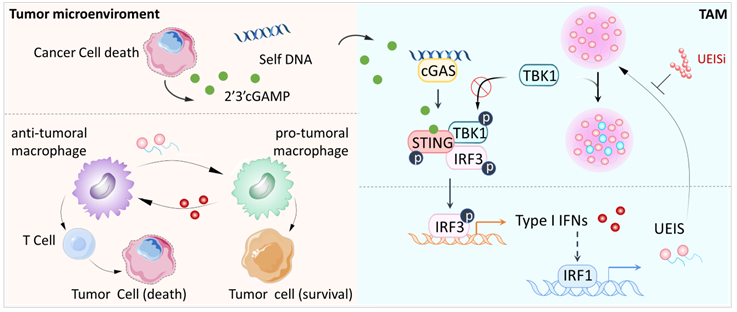
Schematic illustration of UEIS-mediated regulation of tumor immunity in TAMs.