A research team led by Doctor Jiang Hui from the Faculty of Life Sciences and Medicine at Harbin Institute of Technology (HIT) published a study titled Inflammatory kinase TBK1 suppresses homologous recombination DNA repair to sensitize tumors to chemotherapy in Proceedings of the National Academy of Sciences (PNAS).
The study reveals that TBK1, a key inflammatory kinase, can directly inhibit the formation of the PARP1-MRE11 complex through its kinase activity in a manner independent of canonical downstream inflammatory cytokines. This inhibition impairs homologous recombination (HR) repair, exacerbates genomic instability, and ultimately significantly sensitizes tumor cells to chemotherapeutic agents.
This discovery uncovers a non-canonical function of TBK1 in regulating the DNA damage response, providing a novel theoretical basis and potential therapeutic targets for overcoming clinical chemotherapy resistance.
Chemotherapy remains a cornerstone of cancer treatment; however, its efficacy is often limited by tumor cells' robust DNA damage repair (DDR) capacity. First-line chemotherapeutic agents, such as doxorubicin and etoposide, primarily kill cancer cells by inducing DNA double-strand breaks (DSBs).
Nevertheless, cancer cells frequently utilize high-fidelity repair pathways like HR – mediated by key proteins including MRE11 and BRCA1 – to repair this damage, directly leading to chemotherapy resistance. On the other hand, while causing DNA damage, chemotherapy also activates innate immune signaling and triggers inflammatory responses within cells. As a central hub of innate immunity, TANK-binding kinase 1 (TBK1) is well known for activating the IRF3 and NF-κB pathways to induce the production of type I interferons and inflammatory cytokines.
Previous studies have shown that TBK1 acts as a double-edged sword in cancer therapy: it can both promote tumor cell survival and enhance anti-tumor immunity. However, a critical scientific question remains unresolved: Does TBK1-mediated inflammatory signaling directly affect DNA repair efficiency? Is this effect an indirect consequence of downstream cytokine signaling, or does it involve direct molecular regulation?
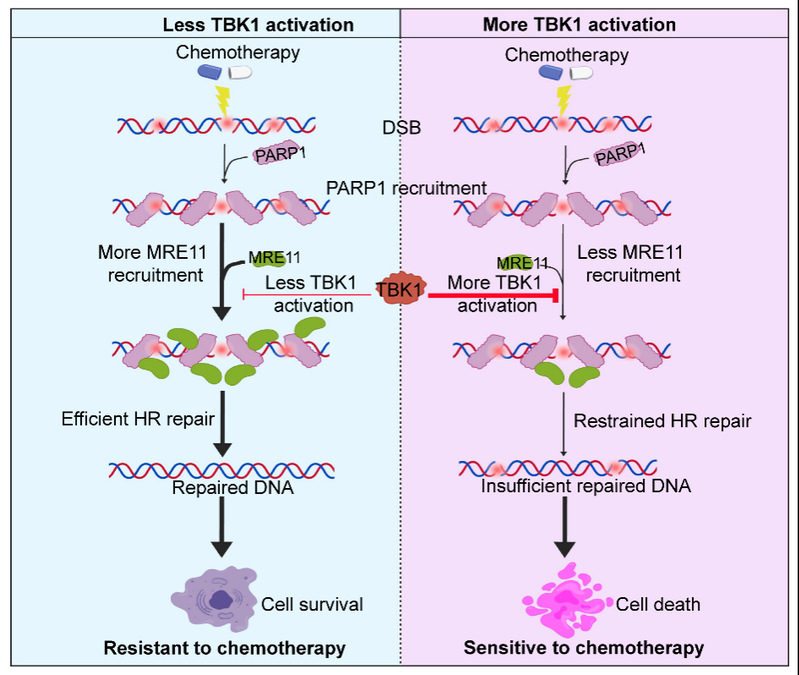
Schematic diagram showing how TBK1 activation enhances chemotherapy efficacy.
To investigate the link between innate immune pathways and chemotherapy, the study found that activating innate immunity in combination with chemotherapy significantly enhances tumor cell killing. This synergistic effect relies on TBK1 activation to amplify DNA damage. Even when IRF3 and p65 were knocked out to block the production of downstream canonical inflammatory cytokines, TBK1 activation still promoted chemotherapy-induced lethality and DNA damage accumulation, a process dependent on an intact p53 signaling pathway.
Building on the finding that TBK1 activation exacerbates DNA damage, the researchers further discovered that it specifically suppresses homologous recombination repair efficiency in a kinase-dependent manner, without affecting non-homologous end joining. Mechanistically, activated TBK1 directly binds to PARP1, physically hindering the assembly of the PARP1-MRE11-Timeless complex. This obstruction impairs MRE11 recruitment and subsequent ATM activation, thereby inhibiting the initiation of homologous recombination; notably, this function occurs independently of changes in protein modification levels.
The loss of MRE11 abolishes the chemotherapy-sensitizing effect of TBK1 activation, inversely confirming the central regulatory role of the TBK1-PARP1-MRE11 axis. In vivo validation using nude mouse xenograft models demonstrated that TBK1 deficiency leads to doxorubicin resistance, evidenced by reduced tumor regression, decreased apoptosis, and enhanced DNA damage repair.
These results confirm that TBK1 presence and activation are essential for maintaining chemotherapy-induced genomic instability and cell death, and that these mechanisms hold even after excluding adaptive immune interference.
In summary, this study reveals a novel role for the activation of the inflammatory kinase TBK1 in cancer biology – as a genome destabilizer. By bridging the two major research fields of immune signaling and DNA damage repair, the study answers the question of how chemotherapy-induced innate immunity feeds back to enhance chemotherapeutic efficacy.
Furthermore, it provides critical new targets and perspectives for developing novel anti-tumor combination strategies, such as overcoming chemotherapy resistance through the combined use of immune agonists in clinical settings.
HIT is the first affiliated institution of this paper. Doctor Jiang is the corresponding author. Doctoral students Zhou Wei and Wang Xiangyu from his research group are co-first authors.
This work was supported by Doctor Lin Deng from Shenzhen Bay Laboratory, the National Natural Science Foundation of China, the HIT Talent Startup funding, and the State Key Laboratory of Space Environment Simulation and Material Interactions.